
Finding Your Stress Pattern: How Stress Management Therapy Reveals What You Can't See Alone

You've tried the breathing exercises. You downloaded the meditation app. You cut back on caffeine, reorganized your schedule, made the to-do list. And still — the stress keeps coming back.
Here's what most stress management advice misses: the strategies aren't the problem. The pattern underneath them is. Stress in your life isn't random. It follows grooves your mind has worn over years — ways of thinking, responding, and coping that feel automatic precisely because they've become automatic. A therapist's job isn't to hand you more techniques. It's to help you see the pattern you can't see from inside it.
Why Self-Help Stress Relief Has a Ceiling for Chronic Stress
Self-help works well for everyday stress — until it doesn't. A deep breath helps when you're stuck in a traffic jam. A walk around the block can shake loose a bad afternoon. These are genuine tools for managing stress levels in the moment.
But for many people, stress in your life isn't just situational. It's structural. The same stressful situations keep triggering the same reactions. You feel overwhelmed in the same way, about the same kinds of things, no matter how many stress management techniques, relaxation practices, or other stress management strategies you try. The tools don't stick — not because you're doing something wrong, but because most stress management advice teaches you to cope with stress after it arrives rather than addressing why it keeps arriving. Mental health improves most durably when you work at the source.
Unmanaged stress carries real health consequences including increased risk of cardiovascular problems, weakened immune function, and disrupted sleep. Stress relief strategies can soften the edges of that experience — but they rarely change the underlying stress response itself. Ongoing stress that isn't addressed at its source tends to wear down emotional well being, physical health, and your capacity to cope with everyday demands. It's particularly insidious because it normalizes — you stop recognizing how much you're carrying.
That's where therapy is different. Therapy targets the source, not just the symptoms.
From the Therapist: We often tell clients who arrive with a list of strategies they've already tried that the issue isn't effort — it's direction. Self-help tools work on the surface level of stress. What they can't do is show you the pattern underneath, because the pattern is what's generating your interpretation of events. In our experience, the moment a client sees their own loop clearly — really sees it — is often the session where things begin to genuinely shift.
What Is a Stress Pattern, Exactly?
A stress pattern is a predictable loop your mind runs when it perceives a threat — real, imagined, or somewhere in between, whether that's a brief episode of acute stress tied to a specific event or a more persistent cycle that starts to feel chronic.
Most people have one or two dominant patterns. You might not have named them, but you've felt them — in the body's physical changes, in your emotional response, in the way certain situations reliably drain you. Here are the most common:
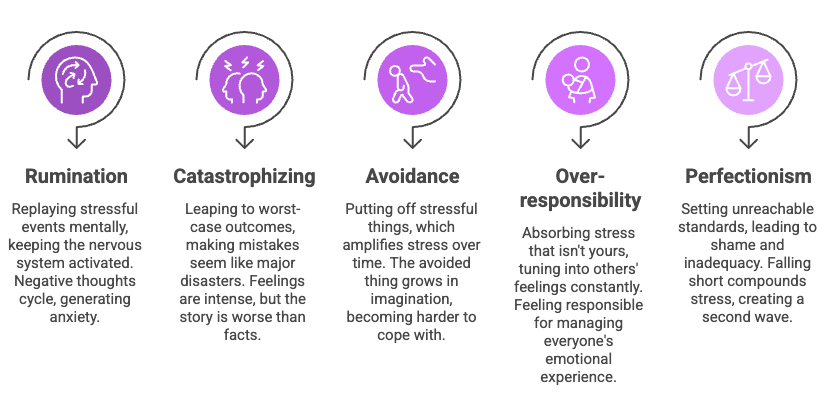
Rumination — You replay the stressful event over and over, trying to solve it mentally. The replay feels productive but actually keeps your nervous system activated long after the threat has passed. Stress levels stay elevated not because of the situation but because of the loop. Negative thoughts cycle through your mind, generating fresh anxiety and tension with each pass — which itself becomes a source of stress.
Catastrophizing — Your mind leaps to worst-case outcomes. One mistake at work becomes "I might lose my job." A disagreement with a friend becomes "This relationship is damaged." Your feelings in those moments are intense and real — but the story driving them is worse than the facts.
Avoidance — You put off the stressful thing. The email sits in drafts. The conversation keeps getting postponed. Avoidance feels like relief in the short term but almost always amplifies stress over time, because the avoided thing grows in your imagination. It's one of the least effective ways to cope with stress — and one of the most common. The more you avoid, the harder it becomes to cope, because the pattern reinforces itself.
Over-responsibility — You absorb stress that isn't yours to carry. You tune into others' feelings constantly — how they're doing, what they need, whether they're okay. You feel responsible for managing everyone's emotional experience. The feelings of guilt or anxiety when you can't fix it compound your own stress. This pattern is exhausting in a way that's hard to trace back to its source.
Perfectionism — You set standards that make chronic stress nearly inevitable. When you fall short (and you always will, because the standard is unreachable), the feelings of shame or inadequacy compound the original stressor, creating a second wave of stress on top of the first.
The critical thing about these patterns: they're largely invisible from the inside. Not because you're not self-aware, but because patterns that have been running for years feel like reality, not like a habit of mind. They shape your feelings, your behavior, and your own thoughts in stressful situations without announcing themselves — which is why the same feelings keep surfacing in different circumstances.
Why You Can't Always See Your Own Pattern
The stress you feel seems self-evidently caused by external events. Everyone experiences stress, but your boss, your finances, your family — and the internal pattern you bring to those pressures — affect how strongly it takes hold in daily life.
This is the central limitation of self-directed stress management. You're working from inside the framework that created the problem. You can learn techniques to manage stress or improve mental health — but applying them requires first noticing the pattern, and the pattern is exactly what's hardest to notice from inside it.
Research confirms that changing cognitions — the way you interpret and respond to stressful events — is the most important mechanism driving stress reduction in therapy. This isn't something that happens through willpower or reading articles. It requires a trained observer who can see what you can't.
A therapist — someone with mental health training focused entirely on your patterns — is that observer. They're listening for what you don't say as much as what you do. They notice when your language shifts — when you go from describing a situation to defending it, or when the emotion in the room doesn't quite match the story you're telling. Over time, they can reflect back a picture of your stress pattern — including which thoughts, feelings, situations, and stress reactivity are most reliably connected — that would take years to piece together on your own.
From the Therapist: In our work, the most persistent stress patterns are often the ones that have been running the longest — which means they feel the most like just "the way things are." A client who has catastrophized since adolescence doesn't experience it as a choice. It's just what the mind does. Part of our job is to create enough distance from that pattern that it becomes something you can see and respond to, rather than something you're simply inside of.
What Therapy for Stress Actually Involves
Effective stress management involves more than coping skills — it's about understanding what's driving the stress and changing your relationship to it. The goal is to manage stress more effectively and cope with it in healthy ways that hold up in daily life, while also supporting physical and mental health, not just in calm moments.
A therapist will help you with individual therapy for depression and anxiety to:
Map your triggers — Which situations consistently produce stress for you? Are there themes across them (performance, relationships, control) that help you take more control in your own life?
Trace the automatic thought — What does your mind tell you in those moments? What feelings get activated, and how quickly?
Examine the evidence — Is that story accurate? What would you tell a friend in the same situation?
Build a different response — Not suppressing the stress or your feelings, but developing a more accurate and less amplifying reaction to stressful events
This process is most associated with cognitive behavioral therapy (CBT), which uses specific stress management techniques — thought records, behavioral experiments, cognitive restructuring — but the pattern-finding work shows up across most effective therapeutic approaches. CBT for chronic stress produces large reductions in perceived stress, with effects maintained at six-month follow-up — strong evidence that therapy does more than teach people to manage stress symptom by symptom.
The therapeutic relationship itself plays a significant role in outcomes, independent of specific techniques. Feeling genuinely heard and understood is itself one of the most powerful ways to manage stress — and one that's hard to replicate with an app. Online therapy platforms can also simplify finding a mental health provider when you're ready to start.
How Long Does It Take to See Results?
Most people notice something shifting within the first few sessions — not full resolution, but a changed relationship to the stress.
You start catching the catastrophic thought before it runs its full course, and some people also find that online group therapy for anxiety offers additional support in practicing these skills between sessions. The feelings that used to ambush you start announcing themselves earlier. You notice the avoidance impulse earlier. You recognize the rumination loop and have a way to step out of it. Feelings that used to spiral — anxiety, frustration, dread, that nagging sense that something is about to go wrong — become easier to cope with because you understand where they're coming from. These moments of recognition are where change actually lives.
Structured therapy for stress produces significant within-group improvements, and the early gains often come faster than people expect. Some people get the most benefit when they pair therapy with simple daily practices between sessions. But addressing patterns that have been running for years is deeper work — and the results compound over time. The deeper work — changing the underlying pattern rather than managing its outputs — takes longer and is more durable. A daily gratitude practice can improve emotional well-being and reduce stress levels between sessions.
What Else Helps Alongside Therapy? Complementary and Integrative Health Approaches
Therapy works best when it's supported by the basics. Here's the thing: not all stress is psychological in origin — some of it is physical, and your body needs tending to as much as your mind does.
Sleep and stress are bidirectional: quality sleep helps your ability to handle stress, while chronic stress can show up as difficulty falling asleep multiple times a week. Most adults need enough sleep — between 7 and 9 hours — to maintain the emotional regulation that makes stress manageable, and a quiet, dark, and cool bedroom supports better sleep quality. Getting enough sleep — ideally 7 to 9 hours each night — isn't optional for mental health or stress recovery. Protecting your sleep is one of the healthy ways to support stress management that has the broadest evidence behind it. It's foundational. Poor sleep habits and chronic stress feed each other; therapy can help you break that cycle too.
A steady routine and regular exercise support everyday stress management by creating more stability in daily life. A healthy diet can also help stabilize your mood, and eating fruits and vegetables supports mental health. Whole grains and other complex carbohydrates may help reduce stress effects, antioxidants help protect cells from chronic stress damage, and reducing sugar intake may lower stress levels.
Physical activity has well-documented effects on anxiety and distress. Increasing physical activity is one of the most accessible changes you can make. It gives your body a healthy way to discharge the physical reactions that stress accumulates. Even walking, running, and swimming are effective stress relievers that improve your capacity to cope over time. Regular physical activity is one of the most evidence-backed stress management techniques available — and one that works synergistically with the pattern-work of therapy to support both physical and mental well-being. Strong self care often includes movement when you're trying to reduce stress.
Social connections matter too: talking with friends can reduce feelings of isolation, spending time with friends can lower stress levels, and social support helps protect against depression and anxiety. Time outdoors in green spaces significantly reduces stress hormones and cortisol.
Relaxation techniques — deep breathing, progressive muscle relaxation, guided imagery, and other forms of meditation — produce immediate physiological relaxation that creates space to think more clearly and can ease signs like muscle tension. Practicing deep breathing for even a few minutes activates the body's calming response — a useful skill for moments when you need to cope before a full therapy session is possible. Relaxation techniques like these complement the pattern-work of therapy by giving your nervous system a way to settle between sessions. Hatha yoga and tai chi work through similar mechanisms, combining physical movement with focused attention.
These aren't alternatives to therapy — they're complements, and for some people family therapy to improve communication and resolve conflict becomes an important part of reducing stress at home. Together they form a complete stress management approach — one that supports physical and mental well-being by addressing both the cognitive patterns driving stress and the physical toll it takes on your body and emotional well being. This is what comprehensive stress management involves: working at the level of patterns, not just symptoms.
Is This the Right Time to Seek Help from a Mental Health Professional?
You don't have to be in crisis to benefit from working with a mental health professional. Self care is often the first step people try before deciding to seek help, and the most common thing we hear from people who finally make an appointment is that they wish they'd come sooner — before stress accumulated to the point of chronic health problems, before long term stress wore down their relationships, physical health, and emotional well being — before long-term stress became something they'd been managing alone for years when it could have been addressed earlier, before they started to feel overwhelmed by things that used to feel manageable.
If stress feels like a recurring character in your daily life — and the same feelings keep getting triggered by the same kinds of situations — that's worth paying attention to, and working with experienced therapists in Baltimore who specialize in stress and anxiety can help you understand why those loops keep repeating. Not because something is wrong with you — stress, anxiety, and strong emotional reactions are a normal part of being a human being, and a positive attitude can help, but recurring patterns still deserve attention because they can affect everyday life and make it harder to enjoy life. A therapist — a mental health professional trained to see what you can't — can help you manage stress in ways that produce lasting change, not just temporary relief. If access feels like a barrier, online therapy platforms can simplify finding a mental health provider.
The good news: it doesn't take forever to find it. And once you see it clearly, it loses most of its power.
From the Therapist: We approach stress in therapy with one consistent belief: there's always a reason the pattern developed, and that reason made sense at some point. Over-responsibility, perfectionism, avoidance — these aren't character flaws. They were adaptations. Therapy isn't about fixing something broken. It's about updating strategies that served you once but are now costing you more than they give — so you can manage stress in ways that actually fit who you are now. That reframe tends to make the work feel less threatening — and more worthwhile. And the payoff isn't just less stress. It's a genuine improvement in well being and in how you move through daily life.
If you're in the Roland Park, Canton, Towson, or Mt. Washington area and stress has started to feel like a fixture in your daily life, the therapists at the Baltimore Therapy Group can help you figure out what's driving it. Schedule an appointment to get started.
Disclaimer: This article is for educational purposes only and is not a substitute for professional medical advice, diagnosis, or treatment. Always seek the advice of your physician or qualified mental health provider with any questions you may have regarding a medical or mental health condition. If you are in crisis or experiencing thoughts of self-harm, please call 988 (Suicide and Crisis Lifeline) or go to your nearest emergency room.