
Understanding the Different Types of OCD: A Complete Guide
Understanding the Different Types of OCD: A Complete Guide
When most people think of obsessive-compulsive disorder (OCD), they often picture someone washing their hands excessively or checking door locks repeatedly. While these are real examples of OCD, they represent only a fraction of how this mental health condition can show up. OCD is far more complex and varied than many people realize.

You might even hear people say "I'm a bit OCD" about being neat or organized. But having OCD is not about being particular or liking things tidy—it's about experiencing significant distress and life disruption from unwanted thoughts and repetitive behaviors. Understanding the different types of OCD can help you recognize real OCD symptoms and seek appropriate treatment.
If you've been diagnosed with OCD or suspect you might have it, understanding the different types can help you recognize your symptoms and seek appropriate mental health care. This guide will walk you through the main types of OCD, what they look like in daily life, and why understanding these different forms matters for treating OCD effectively.
What Is OCD?
Obsessive-compulsive disorder affects 1% to 3% of adults, making it a relatively common mental health condition. OCD is characterized by:
Obsessions: Unwanted thoughts, intrusive thoughts, images, or urges that cause significant distress. These aren't just everyday worries—they're persistent, distressing thoughts that repeatedly intrude into your mind even when you try to ignore or suppress them.
Compulsions: Repetitive behaviors or mental acts performed to reduce anxiety or prevent feared outcomes. These might be visible actions (like washing hands repeatedly) or internal mental rituals (like counting or repeating phrases silently).
The key feature is that these obsessions and compulsions are time-consuming (typically taking at least one hour per day), cause significant distress, and interfere with your daily life, relationships, or work.
Are There Really Different "Types" of OCD?
Here's something important to understand: OCD is a single diagnosis, but it's a highly heterogeneous condition, meaning that OCD symptoms vary widely from person to person.
However, research has identified several symptom dimensions or "types of OCD," where certain obsessions and compulsions tend to occur together. Think of these as themes or patterns that researchers have observed across many people with OCD.
What this means for you:
You're not locked into just one type—most people with OCD have symptoms from multiple dimensions
Your symptoms may change over time as life circumstances shift
Understanding which types of OCD you experience can help guide your treatment
The Diagnostic and Statistical Manual (DSM-5-TR) doesn't officially classify OCD into separate types, but recognizes that obsessions and compulsions can focus on different specific themes. These OCD subtypes are useful for understanding how OCD manifests, even though they're not separate diagnoses.
We often have clients come in saying "I have Pure O" or "I have checking OCD" based on what they've read online. While these labels can be helpful for understanding your symptoms, what matters more for treatment is recognizing the OCD pattern itself—intrusive thoughts that cause anxiety, followed by compulsions that temporarily reduce it. We work with clients to identify their specific obsessions and compulsions so we can tailor effective exposure exercises, regardless of which type or types they have.
What Are the Main Types of OCD?
Research has identified common symptom dimensions in OCD. Let's explore the major types in detail:
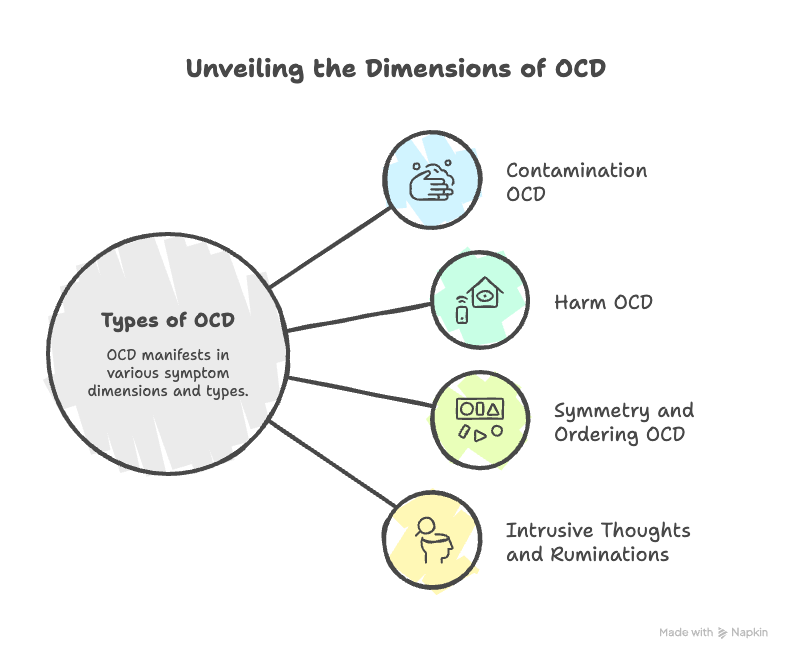
1. Contamination OCD: Fear of Germs and Illness
This is perhaps the most recognizable type of OCD. Contamination OCD involves an intense fear of germs, dirt, illness, or feeling unclean.
Common Obsessions:
Intrusive thoughts about being contaminated by germs, bodily fluids, chemicals, or other substances
Contamination fears about becoming ill or making a loved one sick
Worries about environmental contaminants or toxins
Distressing thoughts about "dirty" objects or surfaces
Fear of physical contact with things perceived as contaminated
Common Compulsions:
Excessive hand washing (sometimes washing hands repeatedly for hours each day)
Prolonged or ritualized showering
Excessive cleaning of household items or surfaces
Avoiding touching doorknobs, public restrooms, or other objects
Using excessive amounts of soap, sanitizer, or cleaning products
Avoiding places or people perceived as contaminated
What makes it OCD: The key difference between contamination OCD and normal hygiene concerns is the level of distress and interference. With OCD, the intense fear feels overwhelming and the compulsive behaviors consume significant time, causing major disruption to daily life.
2. Harm OCD: Fear of Causing Harm
Harm OCD involves fears about being responsible for causing harm to yourself or others, or failing to prevent something bad from happening. This type can be particularly distressing because the intrusive thoughts often involve loved ones.
Common Obsessions:
Unwanted thoughts or mental images of harming family members or other loved ones
Persistent doubts about whether you locked doors, turned off appliances, or closed windows
Fears that you might have accidentally hit someone while driving
Worries about causing a fire, flood, or other disaster through negligence
Intrusive thoughts about sharp objects or potential weapons
Common Compulsions:
Repeatedly checking locks, stoves, light switches, or other appliances
Retracing driving routes to make sure you didn't hit anyone
Seeking to seek reassurance from others that nothing bad happened
Mentally reviewing past events to confirm you didn't cause harm
Avoiding situations where harm might occur (like not driving or not being alone with children)
Important note: People with harm OCD are not violent and do not want to act on these thoughts. The obsessive thoughts are ego-dystonic, meaning they go against the person's true character and values. In fact, people with harm OCD often seek reassurance that they're not a bad person precisely because these thoughts are so distressing and contrary to who they are.
3. Symmetry and Ordering OCD: Need for Things to Be "Just Right"
This dimension involves a need for things to be perfectly symmetrical, even, or arranged in a specific order. It's driven by feelings of incompleteness or intense discomfort when things aren't "just right."
Common Obsessions:
Intrusive thoughts that things must be symmetrical or perfectly balanced
Feelings that something terrible will happen if items aren't arranged properly
Intense discomfort when things are uneven or out of order
Magical thinking that arranging items correctly will prevent harm to a loved one
Common Compulsions:
Arranging items in a specific order or pattern
Organizing objects by size, color, or other characteristics
Repeating actions until they feel "right"
Counting to certain numbers or performing tasks in multiples (like touching something four times in the same way)
Needing to complete tasks in a particular sequence
A key feature: These compulsions are often not connected in a realistic way to preventing harm (for example, arranging books symmetrically to prevent harm to a loved one). This disconnect between the compulsion and the feared outcome is a hallmark of OCD.
4. Intrusive Thoughts and Ruminations: "Pure O"
Sometimes called "Pure O" (purely obsessional OCD), this type primarily involves distressing mental obsessions without obvious visible compulsions. However, people with this type do engage in compulsions—they're just mental acts rather than physical.
Common Obsessions:
Unwanted intrusive thoughts about taboo topics (violence, sexuality, religion)
Disturbing mental images that feel out of character
Obsessive doubts about sexual orientation or identity
Fears about being sexually attracted to inappropriate people
Scrupulosity: excessive concerns about sinning or moral failure
Existential obsessions about the meaning of life or reality
Common Compulsions (Mental Acts):
Mental review or analysis of thoughts
Seeking mental reassurance ("I'm not a bad person")
Trying to neutralize "bad" thoughts with "good" thoughts
Mentally replaying events to check for wrongdoing
Repeating prayers or phrases silently
Avoiding situations that trigger unwanted thoughts
Why it's called "Pure O": Because the compulsions happen internally, people with this type may appear to have only obsessions. But the mental rituals are just as real and time-consuming as physical compulsions—they're simply not visible to others.
Other OCD Subtypes You Might Experience
Beyond the four main categories, clinicians and researchers have identified other specific OCD subtypes:
Relationship OCD (ROCD): Persistent doubts about the quality of your romantic relationship or whether you truly love your partner, leading to compulsive analysis of your partner's flaws or your own feelings.
Hoarding Disorder: An intense fear of discarding possessions, resulting in accumulation of items that clutter living spaces. (Note: Hoarding disorder is now considered a separate diagnosis from OCD in mental disorders classification, though they can co-occur.)
Sensorimotor OCD: Hyper-awareness of automatic bodily functions like breathing, blinking, or swallowing, creating significant distraction and distress.
Checking OCD: A specific focus on repeatedly checking things like locks, appliances, or work to prevent harm or mistakes—a prominent subset of harm OCD.
How OCD Types Affect Daily Life
Regardless of which types of OCD you experience, the impact on your day-to-day functioning can be profound:
Time-Consuming: OCD symptoms typically consume at least one hour per day, though many people spend several hours engaged in obsessions and compulsive behavior. This significantly impacts your ability to work, attend school, or maintain relationships.
Psychological Distress: Living with OCD causes significant anxiety, fear, guilt, and shame. The constant battle with intrusive thoughts and repetitive behaviors can be exhausting and overwhelming.
Social Isolation: The time spent on compulsive behaviors often interferes with social activities. You might go to great lengths to avoid situations that trigger obsessions, leading to isolation from friends and family members.
Work and Academic Impact: OCD can affect your performance at work or school due to the mental energy consumed by intrusive thoughts and the significant amount of time spent on compulsions.
Feeling Trapped: Many people with OCD feel compelled to perform rituals even though they recognize the behaviors are excessive or irrational. This sense of being trapped by your own mind creates distress caused by the condition itself.
In our work with Baltimore-area clients, we've seen every type of OCD imaginable—and often several types occurring together in the same person. What's important to understand is that regardless of which specific obsessions and compulsions you experience, the underlying mechanism is the same. OCD makes your brain interpret normal thoughts or situations as dangerous, then convinces you that performing rituals will keep you or others safe. Recognizing this pattern is the first step toward effective treatment.
Can You Have More Than One Type of OCD?
Absolutely. In fact, most people with OCD experience symptoms from multiple dimensions. For example, you might have both contamination fears and checking compulsions, or symmetry obsessions alongside intrusive thoughts.
Your OCD symptoms can also shift over time. You might start with contamination OCD in your twenties, then develop harm-related obsessions later. New stressors or life events (like becoming a parent or experiencing trauma) can trigger new OCD themes or intensify existing ones.
This doesn't mean your OCD is getting worse—it's just the nature of the condition. The good news is that effective treatment works across all types of OCD, even when symptoms change.
Does Any of This Sound Familiar?
If you're reading this and recognizing yourself in one or more of these descriptions, you're not alone. OCD is more common than many people realize, and it's highly treatable.
You should seek help from a healthcare professional or mental health professional if:
Intrusive thoughts or repetitive behaviors consume more than an hour of your day
You feel compelled to perform rituals even though you know they're excessive
Your symptoms cause significant distress or interfere with work, school, or relationships
You avoid situations or places because they trigger obsessions
You experience symptoms from one or more of the types described above
How Are Different Types of OCD Treated?
The good news is that evidence-based treatments exist for all types of OCD. The most effective treatment is Exposure and Response Prevention (ERP) therapy, a specialized form of cognitive-behavioral therapy (CBT).
How ERP Therapy Works Across Different OCD Types:
ERP therapy is adapted to your specific symptoms but follows the same core principles for treating OCD:
Exposure: Gradually confronting situations or thoughts that trigger your obsessions
Response Prevention: Refraining from performing compulsions
For contamination OCD, this might mean touching a doorknob without washing hands. For harm OCD, it might involve being near sharp objects without seeking reassurance. For Pure O, it might mean allowing intrusive thoughts to exist without engaging in mental rituals.
Therapists personalize ERP exercises for your individual OCD symptoms, working collaboratively to create exposures that target your specific obsessions while helping you resist your particular compulsions.
Medication and Other Treatment Options:
Selective serotonin reuptake inhibitors (SSRIs) may be prescribed to help manage OCD symptoms, often in combination with ERP therapy. For severe, treatment-resistant OCD, advanced treatment options like transcranial magnetic stimulation (TMS) or deep brain stimulation (DBS) may be recommended.
From a clinical perspective, one of the most important things we help clients understand is that OCD is OCD, regardless of the specific theme. Whether your obsessions focus on contamination, harm, symmetry, or intrusive thoughts, the treatment approach is fundamentally the same. We teach you how to tolerate uncertainty and resist compulsions, which breaks the OCD cycle. Many clients worry their particular type of OCD is too unusual or too severe to treat, but we've successfully treated every variety.
Moving Forward
Understanding the different types of OCD can help you recognize your symptoms and feel less alone in your experience. OCD is a complex mental health condition that can manifest in many different ways, but all forms share the same basic pattern of obsessions and compulsions.
The most important thing to remember is that OCD is treatable. With proper OCD treatment—particularly ERP therapy—most people experience significant improvement in their symptoms and quality of life, regardless of which types of OCD they have.
If you're struggling with OCD symptoms, the therapists at Baltimore Therapy Group are here to help. We specialize in evidence-based treatments for all types of OCD, including exposure and response prevention therapy. Schedule an appointment to get started.
Disclaimer: This article is for educational purposes only and is not a substitute for professional medical advice, diagnosis, or treatment. Always seek the advice of your physician or qualified mental health provider with any questions you may have regarding a mental health condition. If you are in crisis or experiencing thoughts of self-harm, please call 988 (Suicide and Crisis Lifeline) or go to your nearest emergency room.