
Is CBT Right for Your Stress and Anxiety? What the Research Shows

If you're struggling with stress and anxiety, you've probably heard about Cognitive Behavioral Therapy (CBT). But does it actually work? How quickly can you expect to see results? And is it the right choice for you?
Cognitive Behavioral Therapy (CBT) is consistently ranked as one of the most effective and well-studied treatments for anxiety, providing practical tools to change unhelpful thought patterns and build lasting coping skills. But understanding what the research actually shows—and how CBT compares to other options—can help you make an informed decision about whether CBT stress and anxiety treatment is right for your situation.
This guide breaks down what we know from rigorous research about CBT's effectiveness for stress and anxiety, who benefits most, how quickly it works, and what to expect if you decide to try this evidence based treatment.
What the Research Shows: CBT Is a First-Line Treatment for Anxiety
CBT is the first-line psychotherapy for anxiety disorders, with medium-to-large effect sizes across generalized anxiety disorder, social anxiety disorder, and panic disorder, and benefits that persist up to 12 months or longer after treatment (Szuhany & Simon, 2022). This isn't just clinical opinion—it's backed by decades of research involving thousands of participants.
A comprehensive 2022 review in JAMA examined 19 randomized controlled trials with 1,138 participants and found that cognitive behavioral therapy produces medium-to-large improvements in anxiety symptoms across different anxiety disorders:
Generalized anxiety disorder: Very large effect (Hedges g=1.01)
Social anxiety disorder: Medium effect (g=0.41)
Panic disorder: Medium effect (g=0.39)
These effect sizes tell us that CBT creates meaningful, measurable improvements in anxiety symptoms—not just statistically significant changes, but differences that actually matter in people's daily life and mental well being.
Research has shown that CBT is effective in treating anxiety, stress, and anger management, with a 2012 study of 269 CBT studies finding it highly successful in managing these conditions when combined with other treatments. This evidence based approach has been studied for many mental health conditions, making it one of the most well-researched forms of talk therapy available.
How Long Do CBT Benefits Last?
One of the most important questions about any mental health treatment is: do the benefits last after therapy ends?
For behavioral therapy, the answer is yes. A 2020 systematic review and meta-analysis of 69 randomized controlled trials involving 4,118 patients examined the long-term durability of CBT effects for anxiety disorders. The research found that CBT was associated with moderate symptom reductions that persisted up to 12 months after treatment completion.
Even more impressively, a 2025 study that followed 93 patients for 2-8 years after completing CBT for generalized anxiety disorder found that 57-77% of participants were categorized as "recovered" years after their therapy ended. This long-term follow-up data demonstrates that the coping skills you learn in CBT can provide lasting benefits well beyond the active treatment period.
Relapse rates after successful CBT were relatively low (0-14% at 3-12 months), comparing favorably with medication approaches where relapse after discontinuation tends to be more common (van Dis et al., 2020). The skills and insights you acquire during cognitive behavioral therapy (CBT) appear relatively stable over time, supporting the theoretical advantage of behavioral therapy in providing lasting benefits through learned coping strategies.
How Quickly Does CBT Work?
Cognitive Behavioral Therapy (CBT) is typically short-term, often lasting 12 to 16 sessions, and includes homework assignments to track triggers and practice new skills. But how soon can you expect to notice improvements?
Many individuals notice meaningful improvements in their anxiety symptoms after as few as 6 sessions of CBT, highlighting its effectiveness in providing quick relief and long-term coping strategies. This relatively rapid onset of benefits is one reason CBT has become such a widely recommended treatment for treating anxiety and stress-related mental health conditions.
A typical CBT course involves:
12-16 weekly sessions of 50-60 minutes each
Structured format: Review of homework, skill practice, planning for the week ahead
Active homework between sessions: Practicing CBT techniques, tracking thoughts, completing exercises
Gradual improvement: Early sessions focus on understanding and skill-building, middle sessions on practicing techniques, later sessions on relapse prevention
The timeline matters because it means CBT is a time-limited treatment with a clear endpoint, not an open-ended commitment. You work toward specific goals with your mental health professional, building skills you can continue using after therapy ends to manage stress and reduce anxiety.
In our work with clients at the Baltimore Therapy Group, we're often asked "How long until I feel better?" Here's what we tell people: while many notice improvements after 6 sessions, CBT isn't passive—it requires active participation and homework practice between sessions. The research shows that people who complete homework assignments consistently tend to have better outcomes. Think of CBT as learning a skill like playing an instrument. The more you practice the techniques, the more natural they become and the better your results.
What Makes CBT Effective: The Core Components
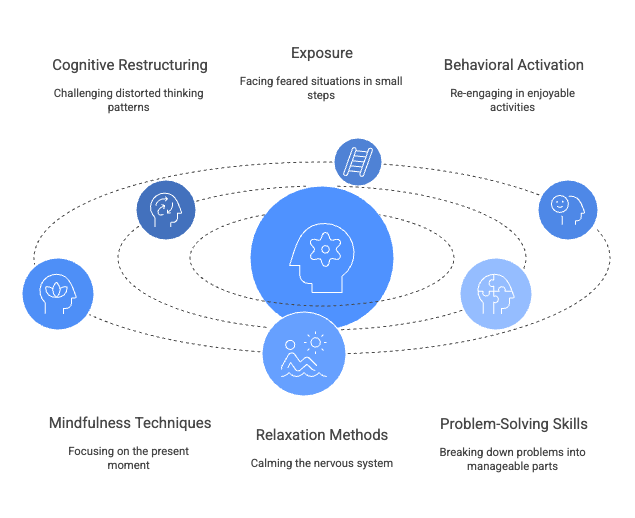
CBT works by addressing three connected areas: thoughts → feelings → behaviors. The core idea is that your thoughts affect how you feel and what you do, and by changing unhelpful patterns, you can improve your emotional health and reduce anxiety. The research shows that certain components are particularly powerful.
Cognitive Restructuring: Challenging Distorted Thinking
Cognitive distortions are patterns of negative thinking that can exacerbate problems and contribute to anxiety. Common cognitive distortions include all-or-nothing thinking, overgeneralization, and catastrophizing, which can lead to increased anxiety and emotional distress and emotional challenges.
CBT helps individuals identify and challenge cognitive distortions, allowing them to replace negative thoughts with more balanced and realistic ones. Cognitive restructuring is a core component of CBT for anxiety, which involves identifying and challenging unhelpful or distorted thought patterns that contribute to anxiety. The goal is to identify negative thought patterns, examine them critically, and develop more balanced thinking.
For example, if you're stressed about a work presentation and thinking "If I make one mistake, everyone will think I'm incompetent" (catastrophizing), cognitive behavioral therapy (CBT) teaches you to:
Notice this automatic negative thought
Examine the evidence for and against it
Develop a more balanced thought like "I might make a small mistake, and most people probably won't notice or will understand"
Journaling and keeping thought records help in tracking triggering events, automatic negative thoughts, and emotions to recognize patterns and test their validity. This written practice between sessions reinforces the cognitive restructuring work you do with your licensed therapist and helps you identify negative thought patterns more quickly over time.
Exposure: Facing Feared Situations
Here's something surprising from the research: exposure-based interventions showed large effect sizes (g=0.78) compared with controls, while cognitive strategies alone showed small-to-medium effects (g=0.38) (Szuhany & Simon, 2022). This tells us that actually facing the feared situations you've been avoiding due to anxiety is particularly powerful.
Graded exposure in CBT involves facing feared situations or activities in small, incremental steps rather than avoiding them. Exposure therapy is an evidence-based approach in CBT that involves gradually exposing individuals to anxiety-provoking situations in a controlled manner to build confidence and reduce fear. This CBT technique directly addresses avoidance behaviors that maintain anxiety over time.
The exposure process might look like:
Creating a hierarchy of feared situations ranked from least to most anxiety-provoking
Starting with less challenging situations
Staying in the situation until anxiety naturally decreases
Discovering that feared outcomes often don't happen, or that you can cope with them
If you have social anxiety about speaking up in meetings, for instance, you might start by making a brief comment in a small team meeting, then work up to presenting to larger groups as your confidence builds. The exposure helps you learn that you can handle tough situations and that anxious thoughts often overestimate actual danger.
From a clinical perspective, exposure is often the component people are most nervous about—and the one that creates the most change. We've seen clients avoid situations for years, convinced that facing them would be unbearable. What consistently happens is this: anxiety peaks, then naturally decreases when you stay in the situation. You learn that you can handle what you feared, or that the feared outcome doesn't happen. The avoidance was maintaining the anxiety, not protecting you from it. This insight is transformative.
Behavioral Activation: Re-engaging with Life
Behavioral activation encourages re-engagement in enjoyable or productive activities to improve mood and disrupt negative thought cycles. When you're stressed and anxious, you naturally withdraw from activities—but this withdrawal actually makes symptoms worse.
CBT helps you:
Identify activities that used to bring pleasure or meaning
Schedule specific activities even when you don't feel motivated
Notice that taking action often improves mood (rather than waiting for motivation first)
Build momentum gradually through small, achievable steps
Research shows that behavioral activation is particularly effective for both depression and anxiety, helping break the cycle where inactivity fuels more distress and interferes with daily life. The Baltimore Therapy Group also provides specialized depression therapy in Baltimore that incorporates these evidence-based strategies.
Additional Techniques That Support CBT
Common CBT techniques include cognitive restructuring, mindfulness or grounding techniques, and relaxation methods like deep breathing and progressive muscle relaxation. These CBT strategies work together to help you manage both the mental and physical symptoms of anxiety.
Breathing exercises and deep breathing help calm the nervous system and reduce physical symptoms of anxiety like rapid heartbeat and shallow breathing. Progressive muscle relaxation is a helpful tool that involves tensing and releasing different muscle groups to reduce the body's stress response.
Mindfulness techniques such as the "5-4-3-2-1" method help to break anxious thought loops and refocus on the present moment. This grounding technique involves noticing:
5 things you can see
4 things you can touch
3 things you can hear
2 things you can smell
1 thing you can taste
Practicing mindfulness is a powerful technique in CBT that helps individuals observe their thoughts without judgment, which can aid in managing anxiety by staying present and avoiding catastrophic thinking. This approach helps you notice unhelpful thoughts without getting caught up in them.
Problem-solving skills in CBT involve breaking down large problems into smaller, manageable parts and developing practical solutions. This structured way helps when stress feels overwhelming by creating actionable steps forward in tough situations.
Who Benefits Most from CBT?
A 2025 landmark meta-analysis examined 375 trials involving 32,968 patients across multiple mental disorders and found that for anxiety disorders, effect sizes ranged from 0.5 to 1.0 for panic disorder, social anxiety disorder, and generalized anxiety disorder, with larger effects (>1.0) for PTSD and specific phobias.
CBT works well for: and practices like the Baltimore Therapy Group offer cognitive behavioral therapy (CBT) in Baltimore for many of these concerns.
Generalized anxiety disorder: Excessive worry about many different things
Social anxiety disorder: Fear of social situations and being judged
Panic disorder: Recurring panic attacks and fear of having more
Specific phobias: Intense fear of specific objects or situations
Stress-related conditions: Chronic stress, adjustment disorder, burnout
Post-traumatic stress disorder (PTSD)
The Baltimore Therapy Group also provides specialized Baltimore anxiety therapy using CBT and exposure for many of these conditions.
Obsessive compulsive disorder (OCD)
For children and families, the Baltimore Therapy Group offers CBT-informed child therapy in Baltimore to address anxiety and related challenges.
Depression (which often occurs alongside anxiety)
Eating disorders (CBT is also effective for many mental health conditions beyond anxiety)
The research also tells us that CBT addressing common underlying anxiety and depression dimensions showed large effects (g=−0.81) (Szuhany & Simon, 2022), meaning if you're dealing with both stress/anxiety and depressive symptoms, behavioral therapy can address both mental health conditions simultaneously.
While CBT is not designed to treat every medical condition or mental illness, it remains one of the most versatile and effective approaches for anxiety-related challenges.
How Does CBT Compare to Other Treatments?
CBT vs. Medication
One of the most common questions is whether to try CBT, medication, or both. Here's what the research shows:
CBT is as effective as medication for most anxiety disorders, and unlike medication, CBT teaches skills you can use for the rest of your life. The research document notes that while both approaches work, CBT has a theoretical advantage: skills learned in therapy provide lasting benefits through learned coping strategies, while medication effects typically end when you stop taking the medication (van Dis et al., 2020).
For severe anxiety or when CBT alone isn't enough, combining CBT with medication (usually an SSRI or SNRI antidepressant) may be helpful. However, routine combination is not always necessary—many people do well with cognitive behavioral therapy (CBT) alone.
A key difference: relapse rates after successful CBT were relatively low (0-14%), while relapse after stopping medication tends to be higher (van Dis et al., 2020). This suggests that the coping skills you learn in cognitive behavioral therapy create more durable change than symptom management through medication alone.
CBT vs. Other Therapy Approaches
A 2024 network meta-analysis compared multiple psychotherapy approaches for generalized anxiety disorder and found that CBT (effect size −0.74) and third-wave CBTs like ACT and MBCT (effect size −0.76) were both associated with significant symptom reduction.
Importantly, when examining long-term outcomes at 3-12 months after treatment completion, only CBT remained significantly more effective than treatment as usual, while other therapies lost their superiority (Papola et al., 2024). This provides strong evidence that CBT should be considered the first-line psychotherapy based on both immediate and sustained effectiveness.
Third-wave CBT approaches that build on traditional CBT include:
Acceptance and Commitment Therapy (ACT): Focuses on accepting difficult thoughts and feelings while taking action based on your values
Mindfulness-Based Cognitive Therapy (MBCT): Combines mindfulness meditation with CBT techniques
Mindfulness-Based Stress Reduction (MBSR): An 8-week program of guided meditation and relaxation
A 2021 meta-analysis found that ACT and MBCT showed comparable effects to traditional CBT on anxiety outcomes, while MBSR showed significantly lower effects than CBT. This suggests that while mindfulness-based approaches are viable alternatives, traditional cognitive behavioral therapy (CBT) remains the benchmark treatment, particularly for sustained long-term benefits.
Internet-Based CBT
If you have difficulty accessing in-person therapy due to scheduling, location, or cost, you might wonder whether online CBT is effective.
A 2016 Cochrane review of 30 randomized controlled trials with 2,181 patients found that therapist-supported internet-based CBT (iCBT) was superior to no therapy and was at least as effective as face-to-face CBT for clinically important improvement in anxiety.
Internet-based CBT was effective for:
Generalized anxiety disorder
Agoraphobia and panic disorder
Social phobia
PTSD
OCD
The review noted that guided interventions with therapist support via email or phone showed larger effect sizes than completely self-directed programs. A 2018 study specifically for chronic stress found that 12-week internet-based CBT produced large improvements in perceived stress (effect size d=1.09) with effects maintained at 6-month follow-up, and many people also benefit from online group therapy for anxiety and related concerns.
This research supports internet-based CBT as a viable alternative for patients who cannot access face-to-face therapy, especially when it includes some level of therapist guidance.
Exercise as a Complement to CBT
A 2021 systematic review examined combining physical exercise with CBT for anxiety disorders and found that add-on exercise appears more beneficial when administered regularly several times per week across several weeks.
Exercise appears to reduce anxiety through different mechanisms than CBT—including exposure to feared physiological sensations (like increased heart rate), neurobiological changes, and improved self-efficacy. The combination of regular physical activity and CBT may be more effective than either alone, particularly when exercise is consistent and sustained and helps reduce physical symptoms of anxiety.
What to Expect in CBT for Stress and Anxiety
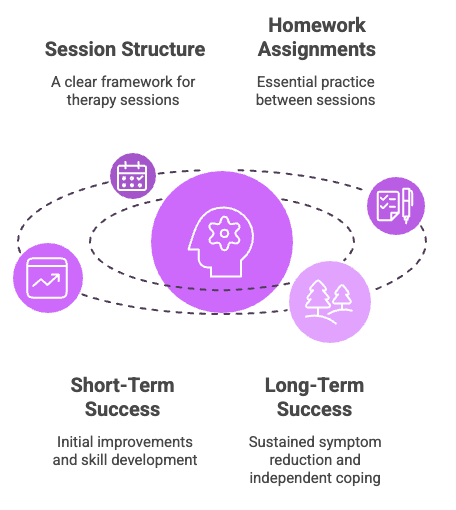
Understanding the actual process can help you decide if CBT is right for you.
Session Structure
CBT is structured talk therapy with a clear framework:
Assessment phase: Your therapist asks detailed questions about your anxiety symptoms, stress triggers, and goals
Skill-building phase: You learn specific CBT techniques like cognitive restructuring, exposure therapy, and relaxation
Practice phase: You apply CBT techniques to real-life situations with therapist guidance
Relapse prevention: You prepare to maintain gains and handle future challenges
Each session typically follows a format:
Review homework and progress from the previous week
Set an agenda for today's session
Learn or practice new coping skills for managing anxiety
Plan homework assignments for the coming week
Homework Between Sessions
CBT includes homework assignments to track triggers and practice new skills between sessions. This active practice is essential—research shows that people who complete homework assignments tend to have better outcomes than those who don't.
Common homework might include:
Keeping thought records to track automatic negative thoughts
Practicing relaxation techniques like deep breathing or progressive muscle relaxation
Completing exposure exercises to gradually face feared situations
Scheduling behavioral activation activities
Reading psychoeducation materials
The homework isn't busy work—it's how you transfer what you learn in sessions to your daily life and learn to ease anxiety more effectively over time.
What Success Looks Like
Based on the research, here's what you might expect from a successful course of CBT:
Short-term (during treatment):
Meaningful improvements after 6 sessions for many people
Better understanding of how your thoughts, feelings, and behaviors connect
New coping skills for managing anxiety and stress
Reduced avoidance of anxiety-provoking situations
Lower overall anxiety and stress levels
Better ability to manage mental health in daily life
Long-term (after treatment ends):
Sustained symptom reduction lasting 12+ months
CBT skills you can continue using independently
Lower risk of relapse compared to medication alone
Ability to handle new stressful situations using CBT techniques you learned
57-77% chance of being "recovered" years after treatment
Improved mental health and overall functioning
Is CBT Right for You?
CBT may be a good fit if:
You want to learn practical skills for managing stress and anxiety
You're willing to actively participate in therapy and complete homework
You prefer a structured way, time-limited treatment approach
You want treatment with strong research evidence behind it
You're dealing with specific anxiety triggers or situations
You want to understand the connection between your thoughts, feelings, and behaviors
You prefer not to take medication, or want to eventually reduce medication use
CBT might be especially helpful if:
Your stress and anxiety interfere with daily life, work, or relationships
You avoid situations because of anxiety
You notice patterns of negative thought patterns that fuel your stress
You want skills that will last beyond therapy
You're experiencing physical symptoms of stress like headaches, muscle tension, or sleep problems
Consider combining CBT with medication if:
You have severe anxiety that makes it hard to engage in therapy
You've tried CBT alone and need additional support
You have other mental health conditions that benefit from medication
Your mental health professional recommends a combined approach
We tell prospective clients that CBT works best when there's a good match between the approach and your preferences. If you want concrete skills, appreciate structure, and are willing to do homework between sessions, CBT is likely a good fit. If you prefer unstructured exploration or aren't ready to actively practice new behaviors, other therapeutic approaches might work better for you right now. The research is clear that CBT is effective—but effectiveness requires engagement, and engagement requires the right fit.
Finding a Qualified CBT Therapist in Baltimore
To find a qualified CBT therapist, you can ask for referrals from trusted individuals such as friends, family, or your primary healthcare provider. You can search for therapists online through local and state psychological associationsto find a CBT therapist who meets your needs, or explore practices that offer expert counseling in Baltimore.
When selecting a therapist, ensure they are state-certified and licensed mental health professionals who treat your specific area of concern, such as anxiety or depression, and consider options for individual therapy for depression and anxiety that fit your needs.
Look for:
Specific CBT training and experience (not all therapists practice CBT even if they list it)
Licensed psychologists, clinical social workers, or professional counselors
Experience treating anxiety and stress-related conditions
Good fit with your preferences and needs
At the Baltimore Therapy Group, our experienced therapists in Baltimore in Towson, Maryland are trained in evidence-based CBT approaches for stress and anxiety. We serve clients throughout Baltimore, Roland Park, Fells Point, Canton, Mt. Washington, and surrounding areas.
Making Your Decision
The research is clear: Cognitive Behavioral Therapy is one of the most effective treatments available for stress and anxiety. It produces meaningful improvements in a relatively short time frame, with benefits that last well beyond the end of treatment.
Whether CBT is right for you depends on your specific situation, preferences, and goals. The evidence shows it works—but like any treatment, its effectiveness depends on your active participation and willingness to practice new skills.
If you're ready to learn practical, research-backed CBT strategies for managing stress and anxiety, cognitive behavioral therapy (CBT) offers a structured path forward with decades of evidence supporting its effectiveness. You can schedule therapy with a Baltimore CBT provider to take the next step.
If you're ready to start CBT or want to learn more about how it might help with your stress and anxiety, schedule an appointment with the Baltimore Therapy Group today.
If you're in crisis: The Baltimore County Crisis Response System is available 24/7 at 410-931-2214. The Suicide and Crisis Lifeline is available nationwide at 988.
Disclaimer: This article is for educational purposes only and is not a substitute for professional medical advice, diagnosis, or treatment. Always seek the advice of your physician or qualified mental health provider with any questions you may have regarding a medical or mental health condition. If you are in crisis or experiencing thoughts of self-harm, please call 988 (Suicide and Crisis Lifeline) or go to your nearest emergency room.