
Should I Try EMDR? A Baltimore Therapist's Guide to Who It Helps

If you've been in therapy for trauma — or if you've been avoiding therapy because talking about what happened feels impossible — you may have come across EMDR therapy. Eye movement desensitization and reprocessing has a somewhat unusual name and an even more unusual treatment process, and people often have questions before they're willing to try it.
This post is designed to answer those questions clearly: what EMDR therapy is, who it helps, what actually happens in sessions, and how to know if it might be right for you.
What Is EMDR Therapy?
EMDR — Eye Movement Desensitization and Reprocessing — is a structured psychotherapy developed by psychologist Francine Shapiro in the late 1980s. Eye movement desensitization and reprocessing EMDR therapy uses guided eye movements and other forms of bilateral stimulation to process distressing memories, and has become one of the most extensively researched psychotherapy approaches available. It was originally designed to treat post traumatic stress disorder and has since become one of the most extensively studied trauma treatments available.
The current state-of-the-science review of EMDR confirms support from more than 30 published randomized controlled trials, with first-line recommendations from the World Health Organization, the American Psychiatric Association, and the U.S. Department of Veterans Affairs. That level of endorsement across major international health bodies puts EMDR in a small group of treatments with the strongest possible evidence base.
How EMDR Therapy Works
EMDR therapy works by helping the brain reprocess traumatic memories that have become "stuck." Treating PTSD and other mental health conditions through EMDR involves shifting both negative beliefs about the self and the stored emotional distress, replacing them with more adaptive positive beliefs.
Why traumatic memories are different
When something traumatic happens, the brain's normal memory processing can be disrupted. The memory gets stored with its original emotional charge intact — the feelings, sensations, and negative beliefs that accompanied the traumatic events remain activated rather than settling into the past where they belong. This is why traumatic memories don't feel like other memories: they intrude, they feel present, they trigger the same body sensations as the original experience.
What bilateral stimulation does
EMDR therapy uses bilateral stimulation — typically guided eye movements following the therapist's hand or a light bar, though tapping or auditory tones are also used. These eye movements occur while the person keeps a target memory in mind. The client attends to the disturbing event while following the external stimulus.
One proposed mechanism: bilateral stimulation while simultaneously engaging with a distressing memory may reduce its vividness and emotional charge, allowing the brain to reprocess and integrate it more adaptively. In practical terms, the memory becomes less overwhelming — the emotional distress decreases, the physical sensations calm, and the person can think about the event without being flooded by it.
The 8 phases of EMDR therapy
A full course of EMDR therapy involves eight structured phases:
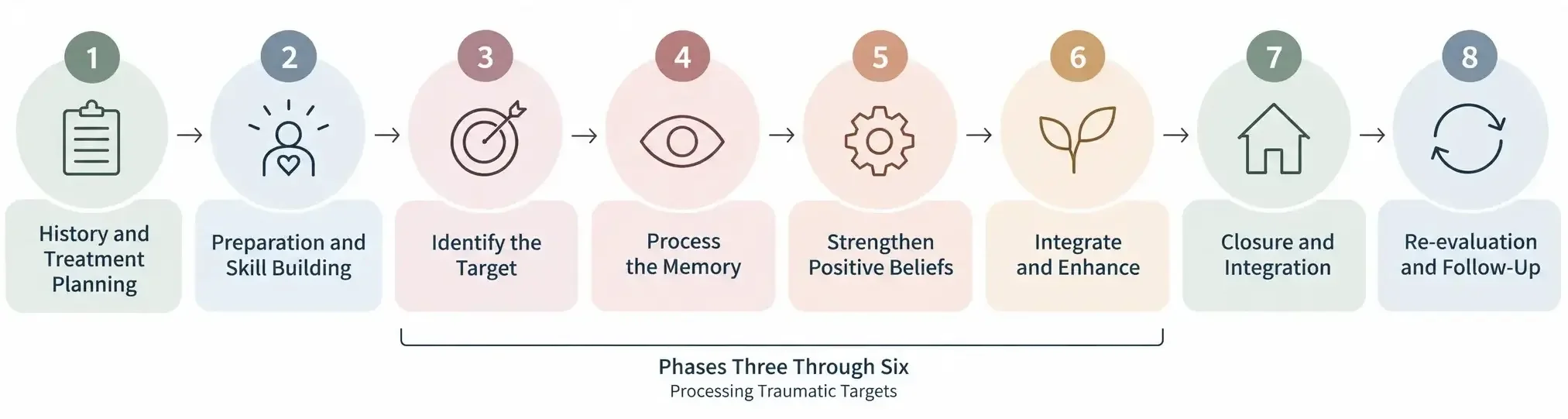
History and treatment planning — gathering your history; identifying target memories
Preparation — explaining the process; building stabilization skills
Assessment — identifying the specific memory, the negative beliefs associated with it, and the desired positive beliefs to install
Desensitization — the bilateral stimulation phase; processing the distressing memory
Installation — strengthening the positive belief
Body scan — checking for residual physical tension or distress
Closure — ensuring you leave each session in a stable state
Reevaluation — reviewing progress at the start of the next session
The therapist guides the client through each phase, ensures the process is paced appropriately, and helps with stabilization between EMDR sessions.
Who EMDR Helps
For many people navigating the ongoing impact of traumatic experiences, dedicated trauma therapy in Baltimore offers a broader framework for healing, with EMDR as one of several evidence-based options.
People with PTSD
EMDR is most strongly supported for posttraumatic stress disorder. A 2025 systematic review and meta-analysis found EMDR produced significant PTSD symptom reductions compared to waiting list controls.
EMDR is effective across a wide range of traumatic events and traumatic experiences — single-incident and repeated — including: military combat, sexual assault, childhood abuse, accidents, medical crises, natural disasters, and the more diffuse but equally real effects of chronic emotional stress or neglect.
People who struggle to talk about what happened
One of EMDR's most clinically significant features is that it doesn't require the person to talk about their trauma in detail. The processing happens internally, guided by the bilateral stimulation, rather than through extended verbal narration. This makes it particularly valuable for people who feel unable or unwilling to describe what happened out loud — whether because of shame, dissociation, or simply the sense that talking hasn't helped.
People for whom talk therapy hasn't been enough
Difficult experiences can be stored in the body and in pre-verbal or implicit memory in ways that talking doesn't always reach. EMDR engages the memory at the level where it's stored — not primarily as a narrative, but as a sensory and emotional experience. Many people who have done significant talk therapy find that EMDR addresses what remained.
People with anxiety, depression, and other conditions
EMDR's applications extend beyond PTSD. A systematic review of EMDR for conditions other than PTSD identified positive effects across 90 studies covering anxiety, depression, OCD, phobias, grief, eating disorders, chronic pain, and sleep disturbances. In our practice, this often means integrating EMDR with anxiety therapy for Baltimore clients, specialized depression treatment in Baltimore, and evidence-based OCD therapy when symptoms are linked to unprocessed experiences. Not everyone with these mental health conditions is a candidate for EMDR, but for those whose symptoms are driven by unprocessed distressing events, EMDR offers an effective treatment path. The reprocessing of distressing memories is the shared mechanism across all these applications.
When EMDR May Not Be the Right Starting Point
EMDR is not appropriate for everyone in every circumstance. Some situations where it may not be the right fit, or where additional preparation is needed first:
Active psychiatric instability — people in acute crisis, with active psychosis, or with very severe dissociation typically need stabilization work before EMDR processing begins
Substance dependence — active substance use can interfere with processing; sobriety and stabilization are usually prerequisites
Insufficient resourcing — people without adequate coping skills or emotional regulation capacity may need preparatory work before the desensitization phases
Specific medical conditions — some neurological or cardiovascular conditions may require modification of the standard protocol
A thorough assessment with a trained EMDR therapist will clarify whether you're ready for the processing phases, or whether preparatory work is needed first.
From the Therapist
"One question we're often asked is whether EMDR works even if you can't remember the details of what happened clearly, or if your trauma was more gradual than a single event. The answer is yes — EMDR is designed to work with whatever form the memory takes, including body sensations and emotional impressions that don't come with clear narrative. You don't need a complete story. You just need to be willing to work with what's there."
What to Expect from EMDR Sessions
EMDR sessions typically run 50–90 minutes. EMDR works differently from other psychotherapy approaches — most people describe the processing as feeling both intense and oddly efficient, with shifts that happen within and between sessions. The early sessions focus on history, relationship-building, and preparation. Processing sessions involve the bilateral processing phases and can be emotionally intense — many clients do experience strong feelings or tears during sessions.
This is expected and not a sign that something is going wrong. Research on EMDR's clinical and cost-effectiveness confirms emotional activation during sessions is a normal part of effective processing, and that the therapist ensures clients can manage it safely. Most people feel more settled at the end of a session than they did mid-session, as the processing completes.
Between sessions, some people notice memories surfacing, negative thoughts arising, or emotions continuing to process. Keeping a log of these experiences and sharing them with your therapist is part of how the treatment is guided.
How many sessions does EMDR take?
The number of EMDR sessions varies considerably depending on the complexity of the trauma, the number of target memories, and individual factors. Some people with a single-incident trauma see significant change in 3–5 sessions. Complex or developmental trauma — trauma that began in childhood or was chronic — typically requires more.
Asking the Right Questions Before You Start
If you're considering EMDR, some useful questions to ask a potential therapist — especially when you're looking for experienced therapists in Baltimore and want to understand their overall counseling approach in Baltimore:
Are you trained and certified in EMDR therapy?
Have you worked with people dealing with the kinds of presenting concerns I have?
How do you determine whether someone is ready for processing phases?
What does the preparation phase look like in your practice?
How will we know if it's working?
From the Therapist
"The question we hear most often from people considering EMDR is some version of "is this going to make things worse?" Trauma processing does bring up difficult feelings. What we tell people is that the preparation phases exist precisely for this reason. We don't begin processing until we're confident you have stabilization skills to manage what comes up. The goal is to process at a pace that is safe and sustainable — not to overwhelm."
EMDR at the Baltimore Therapy Group
Baltimore Therapy Group offers EMDR therapy through a therapist with specialized EMDR training, working with adults navigating PTSD, anxiety, and the lasting effects of difficult experiences. As a practice, the Baltimore Therapy Group is currently accepting new patients for both EMDR and other forms of therapy. We see clients in Roland Park, Canton, Towson, and Federal Hill, and you can schedule therapy appointments in Baltimore for online or in-person sessions.
From the Therapist
"We want to be honest about what EMDR is and isn't. It's not magic, it's not always quick, and it requires real courage. What it is is one of the most evidence-supported trauma treatments available — one that many people describe as reaching something that years of talk therapy hadn't. If you've been carrying something heavy for a long time, it's worth finding out if EMDR can help you set it down."
If you're wondering whether EMDR might be right for your situation, the best next step is a consultation. For some people, that might also include exploring online group therapy options, specialized perinatal mental health support, or a more holistic trauma therapy approach that integrates EMDR with other mind–body modalities. An initial conversation can help you understand whether EMDR therapy is appropriate, what the process would look like, and what to expect.
Not sure where to start?
Talk to a Baltimore therapist who can work with you.
Disclaimer: This article is for educational purposes only and is not a substitute for professional medical advice, diagnosis, or treatment. If you are in crisis or experiencing thoughts of self-harm, please call 988 (Suicide and Crisis Lifeline) or go to your nearest emergency room.